
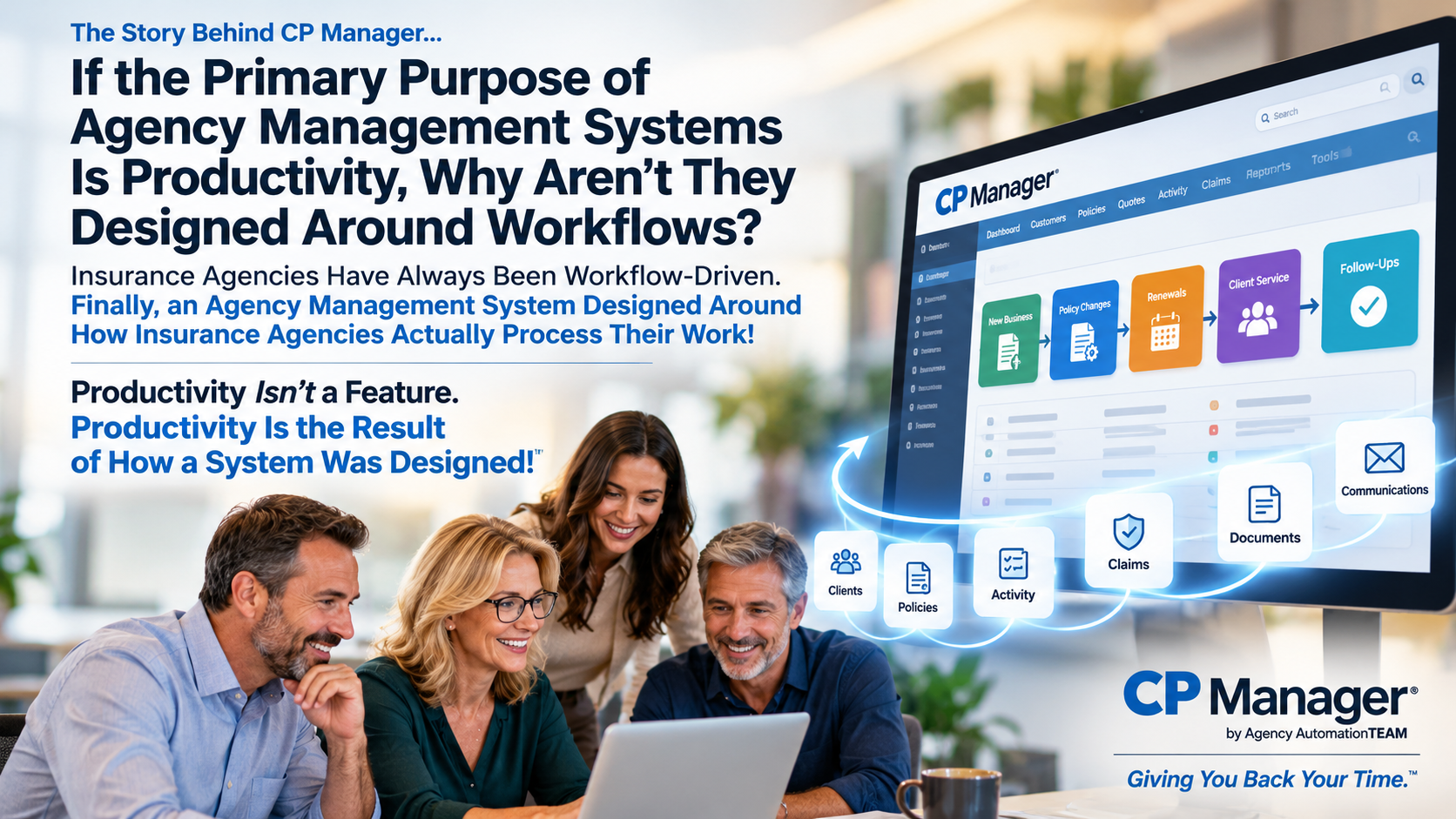
The Story Behind CP Manager...
If the Primary Purpose of Agency Management Systems Is Productivity, Why Aren't They Designed Around Workflows?
Insurance Agencies Have Always Been Workflow-Driven. Finally, an Agency Management System Designed Around How Insurance Agencies Actually Process Their Work!
Productivity Isn't a Feature. Productivity Is the Result of How a System Was Designed!
By Bradley Chesnut, Founder & Designer Of CP Manager
Why would anyone in their right mind spend 15 years re-engineering an agency management system from the ground up? Or take on the challenge of building a system that other vendors couldn't—or wouldn't—build?
Maybe I'm a glutton for punishment.
Or maybe it's because I love this industry, and after years of frustration with agency management systems missing what I consider the single most important piece, I finally came to a realization... If the agency management system I envisioned was ever going to become a reality, I was going to have to build it myself.
So grab a cup of coffee, close your door, and let me tell you the story.
I'll share what led me to take on this extraordinary challenge, how we spent 15 years turning thousands of pages of blueprints into a working system, and how we created what I believe is the industry's first truly workflow-driven agency management system.
And most importantly, why this fundamentally different approach to system design matters to agencies that want to maximize productivity and increase profitability.
There are several core reasons why agencies invest in an agency management system:
- Increase staff productivity. Help staff process more business in less time. This has always been one of the primary objectives of agency automation. After all, much of the work performed in an agency revolves around policy transactions such as new business, renewals, endorsements, cancellations, and claims.
- Improve client service. Give users quick access to current policy information, previous conversations, attached documents, and everything else they need to service clients quickly, efficiently, and accurately. And believe me, there's a lot more to this than meets the eye!
- Handle agency accounting. Manage agency-billed business, producer commissions, carrier payables, premium financing, commission transfers where required, and the agency's overall accounting needs.
- Meet carrier requirements. Some insurance carriers require agencies to have an agency management system as a condition of receiving an appointment.
These are the core reasons, but certainly not the only ones. And as agencies grow, so do their expectations of what their management systems should help them accomplish.
From the early days of agency billing and accounting systems to client and policy management, paperless offices, carrier downloads, and today's increasingly sophisticated technology, the industry has made tremendous progress.
And throughout that evolution, one objective has remained remarkably consistent: Helping agency staff accomplish more work in less time.
Yet after decades of technological advancements and hundreds of new features, an important question remains:
Are today's agency management systems helping the agency staff become as productive as they could be?
After decades of working with independent insurance agencies, I've come to realize that the answer is consistently no.
And understanding why ultimately led me down a path I never expected to take—a 15-year journey to create CP Manager, an agency management system designed around a fundamentally different approach to achieving greater productivity.
This is my story, and why I decided to take on such a massive project.
1. From Insurance Agent to Automation Consultant — How It All Began
I Got Into This Industry As An Agent, Then Agency Partner
My involvement in the insurance industry began in 1985 when I became an insurance agent. A year later, I became a partner in an independent insurance agency.
My strength in growing the agency was my marketing background. We initially had 10 typists typing personalized marketing letters on typewriters.
Can you imagine that? TEN typists!
When I tell people about this, they usually shake their heads in amazement—or maybe disbelief!
A Software Program Changed Everything, Including My Career Path
Then I was introduced to a software program called Q&A by Symantec. It was a DOS-based program that combined a database, letter writer, and reporting capabilities.
The possibilities amazed me, especially when I thought about the payroll for those 10 typists!
But first, I needed a computer to run it.
I ended up spending around $2,800 on my first computer, complete with a 30 MB hard drive and an EGA monitor.
I share this partly for the nostalgia. It's hard to believe what I paid for that computer back in 1986, especially when you consider how far computers have come and what they cost today.
The first program I wrote was a database where I could enter names and addresses, then create personalized marketing pieces using the letter writer. Direct mail was our primary marketing strategy.
By mail-merging the contacts into those letters, I could produce fully personalized marketing pieces.
Even using a dot-matrix printer (printers have come a long ways since those days also), I could produce significantly more marketing pieces in a day than our 10 typists could! And no errors.
We no longer needed the typists, saving the agency a bundle in payroll. And those savings went straight to our bottom line!
From there, I added commission management for the agents we had hired.
Between the mail-merging and commission management capabilities of the database program I'd written, I was in heaven!
I absolutely loved the results we were getting. And more importantly, it opened my eyes to what automation could accomplish.
I was hooked!
Keep in mind, back in the early 1980s, only a small percentage of independent agencies had computers. It was like the Wild West of agency automation!
In 1989, I sold my interest in the agency and began consulting with other independent insurance agencies. Initially, I focused on helping agencies improve their marketing.
But I kept running into the same frustrating problem.
Agencies couldn't handle all of the leads I was generating for them!
And since I was paid based on results—the revenue my marketing generated—their inability to work those leads was costing me a bundle!
How I Got Into Agency Automation
That's when I made a significant shift in my career.
Instead of focusing primarily on generating more business, I began focusing on helping agencies become more productive so they could handle more business.
I helped them improve their operations, implement technology, and increase staff productivity and profitability.
Back then, I had developed quite a reputation for my marketing expertise. But because of those earlier experiences, I eventually refused to work with an agency unless they first addressed their automation and productivity.
I'd learned a valuable lesson.
What good is generating a flood of new business opportunities if your staff don't have the ability to handle them?
You can't effectively put great marketing ahead of properly automating an agency. You need the staff to be able to handle more work in less time.
After all, somebody still has to work those leads!
My Experiences In This Industry Are Extensive
Over the years, I've had the opportunity to experience this industry from perspectives that few people have.
I've been an insurance agent, an agency owner, a consultant, and a software programmer. I've developed software to fill gaps in agency automation, including a full-blown agency management system for a specialty agency.
I've also worked closely with three different agency management system vendors, gaining firsthand experience with how these companies develop their products, make decisions, support their customers, and approach agency automation.
And I've spent countless hours working directly with agency owners, managers, CSRs, and producers—studying how they perform their work and helping them improve their productivity and do their job better, and in less time.
Along the way, I became highly proficient in developing agency workflows, creating workflow manuals, and implementing productivity strategies.
2. The Problem I Kept Seeing for Decades
Those experiences gave me a unique perspective on agency management systems: not just what they could do and their limitations, but how effectively they helped agency staff get their work done.
And one thing became very clear:
Agency management systems are NOT created equal!
Even back then, and consistently throughout the years, I saw significant differences in staff productivity between agencies using different management systems.
CSRs using one system could manage considerably more policies than CSRs using another, simply because of how their management systems were designed.
As Management Systems Evolved, One Problem Persisted
Over the decades, I watched management systems evolve.
I remember when agencies maintained mountains of paperwork in filing cabinets. Then came T-Filing, followed by document imaging and the movement toward paperless offices.
I watched carrier downloading evolve and dramatically reduce the amount of policy information agency staff had to enter manually.
These were meaningful advancements, and I enthusiastically helped agencies implement them.
But as management systems became more sophisticated and the number of features continued to grow, I kept encountering the same fundamental problem.
Agency staff were still spending far too much time performing work that their management systems should have made easier.
They were navigating multiple screens, reentering information, moving between disconnected functions, and performing unnecessary steps to complete routine activities.
And because these activities were repeated throughout the workday, even small inefficiencies became significant productivity problems.
You need to understand something. Agency owners hired me to help their staff become more productive.
But no matter how much I improved their procedures, trained their staff, or introduced better productivity strategies, I could only work within the limitations of the management system they were using.
Let Me Give You an Example
Suppose you need to replace the roof on your house, and a storm is coming. Time is of the essence!
You have two roofing crews to choose from. One uses hammers. The other uses nail guns and can accomplish the same work in one-quarter of the time.
Which crew would you hire?
Seems like a pretty easy decision, doesn't it?
Well, that's essentially what I was dealing with.
Some agencies were using management systems that were the equivalent of roofers using hammers, while others had systems that were much closer to using nail guns.
Both could get the job done.
But the amount of time and effort required to accomplish that same work could be dramatically different!
And here's what concerned me most.
Many agencies didn't recognize just how much their management systems were limiting their productivity.
They had become accustomed to working the way their software required them to work.
But I knew from experience there were much more efficient ways to accomplish many of those same tasks.
The problem wasn't necessarily the staff or their procedures. Often, it was the way the management system itself had been designed.
Over time, the limitations imposed by management system design became one of the biggest obstacles I faced in helping agencies achieve the level of productivity I knew was possible.
Oh sure, I was helping their staff become more productive.
But I knew they could accomplish so much more if their management systems weren't holding them back!
3. The Realization That Changed Everything
For decades, agency management system vendors have competed by introducing new features and capabilities.
And there's certainly nothing wrong with that. New features have played an important role in advancing agency automation.
But if the number of features were the name of the game, shouldn't every agency be using Applied Epic or AMS-360? After all, these systems offer an extensive range of features and capabilities.
But the number of features isn't what determines how productive an agency will be!
I know that from years of talking with agencies using these systems. I've heard comments like:
“We only use about 15–20% of the system.”
Or:
“We only use a fraction of the features, but we're still paying for all of them because they're bundled into the system.”
And when I asked what they really wanted from their management system, the answer was much simpler: “We just want to service our clients and their policies. That's really what we need.”
Exactly!
The objective isn't to have the most features. It's to have the tools the staff actually need, designed to help them accomplish their work as efficiently as possible.
At Some Point I Had A Revelation
As my career progressed, I began recognizing something that fundamentally changed how I looked at agency management systems.
By this point, I had become highly proficient in developing agency workflows, creating workflow manuals, training CSRs, and implementing strategies to improve staff productivity.
And the more I worked with agencies and their management systems, the more obvious something became.
Agency management systems weren't being designed around the workflows agency staff performed every day. They were being designed around the features the system's designers believed agencies needed.
This frustrated me because the insurance industry has been workflow-driven from day one!
Think about it.
When a CSR processes an endorsement, there are established steps to follow. The same is true for renewals, cancellations, new business, and virtually every other policy transaction.
And these workflows are remarkably consistent throughout the industry!
Sure, individual carriers may have additional requirements, but the fundamental steps involved in processing these transactions are largely the same.
So I kept asking myself:
If the insurance industry is workflow-driven, shouldn't management systems be workflow-driven too?
Seems pretty obvious, doesn't it?
After all, isn't one of the primary purposes of an agency management system to help CSRs process policy transactions as quickly and efficiently as possible?
But Then I Recognized a Second, Equally Important Problem
Even if we automated the workflows, that alone wouldn't necessarily make agency staff as productive as they could be.
Here's why.
Every workflow consists of a series of steps. And many of those steps require staff to use the management system's core features, such as Notes, Follow-Ups, Attachments, and Correspondence.
But what if those features themselves weren't designed to be as efficient as possible?
- What if adding a note required unnecessary steps or didn't capture key information or link to all of the places it needed to link to?
- What if creating a follow-up meant navigating multiple screens, didn't clearly tell you who you're following up with and how you should be following up with them, didn't make it easy to open up the records required to handle the follow-up?
- What if users had to repeatedly enter information the system already had?
Automating a workflow wouldn't eliminate those inefficiencies. The individual steps would still require unnecessary work!
That's when the bigger picture came into focus.
To truly maximize agency productivity, I needed to accomplish two things:
- Automate the workflows so the management system could guide users through the steps required to process policy transactions, reducing the amount of manual work and knowledge required. (Wait until you see what we're developing here!)
- Re-engineer the individual features used within those workflows so each step could be completed with as little time and effort as possible, while providing the functionality users actually need for the policy task they're processing.
And just as importantly, those features needed to be tightly integrated throughout the system so they worked together rather than operating as separate, disconnected functions.
It wasn't enough to automate the workflows. I needed to make the individual steps within those workflows more efficient, too!
But as significant as these realizations were, there was still another problem. And this one turned out to be huge!
Still One More Problem To Solve, And This One Was Huge!
Over the years, while working with agencies, I frequently encountered inefficiencies in their management systems that I believed could be corrected. So I did what seemed logical.
I made recommendations to the vendors, explaining how relatively simple changes could eliminate unnecessary work and improve staff productivity.
Unfortunately, time and time again, I heard essentially the same response: “Our table structures won't support that.”
What?
Their table structures wouldn't support the changes I was recommending?
Seriously? How could that be?
Thanks to my programming experience, even though I was shocked with their answer, I understood what they were telling me.
The problem wasn't necessarily that the vendors didn't want to make the improvements.
Their underlying database structures simply weren't designed to support them.
And that's a much bigger problem than an inefficient screen or a feature that requires too many steps.
You can redesign a screen. You can improve a feature. But if the underlying table structures won't support the changes you're trying to make, you're facing limitations built into the very foundation of the system.
And those limitations can affect what the system is capable of accomplishing for years to come.
That's when I realized that achieving the level of productivity I envisioned would require more than redesigning features and integrating workflows. The entire system would need to be built on table structures specifically designed to support those objectives.
I wasn't simply looking for another agency management system with more features or better workflow capabilities.
I was looking for a fundamentally different approach to designing an agency management system—one built around maximizing staff productivity from the ground up.
And that realization eventually led me to a decision I never originally intended to make.
4. Why I Finally Decided to Design CP Manager
I Tried to Find an Easier Solution First
I didn't set out to create another agency management system. In fact, building one was the last thing I wanted to do!
I loved working with independent insurance agencies, helping owners improve their operations, showing CSRs how to become more productive, helping producers use their systems to write more business, and finding ways to make agencies more successful.
And I knew how much difference the right technology could make.
But I was becoming increasingly frustrated with the limitations of the management systems available.
So before committing to developing an entirely new system, I thoroughly investigated what was already on the market.
My preference was to find an existing system I could represent and use to help agencies achieve the productivity improvements I knew were possible.
That would have been considerably easier, faster, and less expensive than creating a new management system from scratch.
Believe me, knowing what I know today about how long this project would take, that would have been a MUCH easier road!
But I couldn't find a suitable long-term solution.
Then I Made a Decision I Never Expected to Make
If I wanted an agency management system truly designed around productivity and workflows, I was going to have to take on the project myself.
I knew this wouldn't be easy.
I also knew I couldn't simply copy the design of an existing management system, add a few features, and expect dramatically different results. That would risk carrying the same limitations into the new system.
Instead, I would have to approach the entire design differently.
And that's exactly what I decided to do.
Workflows Were One of My Biggest Frustrations
One of my greatest frustrations was watching everything a CSR had to go through to process a policy task.
It sometimes seemed as though the system's designers had given little consideration to the workflows agency staff performed every day. Instead, the emphasis appeared to be on providing the individual features needed to get the work done.
The insurance industry has been workflow-driven from day one. It boggled my brain that workflows weren't a fundamental part of how management systems were designed!
But there was another important problem.
Training CSRs on workflows was one of the most difficult and time-consuming parts of bringing new staff into an agency.
And there's a good reason for that.
The correct workflow for processing a policy task is determined by three things:
- Line of Business
- Carrier
- Policy Task
Change any one of those, and the steps involved may change.
That means a CSR must learn and remember numerous different workflows. Then add to this any special requirements individual carriers may have.
That's a tremendous amount of information for someone to learn, remember, and apply correctly throughout the workday. Just trying to remember these steps alone decreases productivity!
Anyone who's spent much time working as a CSR knows exactly what I'm talking about!
Yet despite decades of advancements in agency management systems, much of that responsibility still rests with the CSR.
I kept asking myself: Why couldn't the management system do more of that work?
That question became the inspiration for one of the most important features I envisioned for CP Manager.
A feature I called the Workflow Task Manager (WFTM).
But I knew I couldn't simply build it as another standalone feature.
If I wanted the WFTM to deliver the results I envisioned, the entire management system would first need to be designed to support it.
And that brings me to one of the most important—and challenging—parts of creating CP Manager.
I Spent an Entire Year Creating the Blueprint
Before programming began, I spent a full year developing a comprehensive blueprint for CP Manager.
Not a brief outline of features.
Not a list of screens to create.
A detailed, thousands-of-pages-long blueprint describing how the system needed to work, how information would flow through it, and how its features would integrate to support agency workflows.
I dissected the CSR's job, mapping out workflows policy task by policy task.
I examined the fundamental functions of an agency management system, including Notes, Follow-Ups, Attachments, Correspondence, client and policy information, and the tools staff use throughout the day.
Features weren't added just so we have them. They were added because they supported the workflow and were needed to handle the task at hand.
Rather than simply duplicate how other systems handled these functions, I analyzed how each could be redesigned to eliminate unnecessary work and better support the tasks agency staff performed.
But there was something even more important.
The underlying table structures.
Remember how other vendors had repeatedly told me their table structures wouldn't support the productivity improvements I recommended?
Well, I wasn't about to spend years creating a new management system only to discover that I'd built those same limitations into it!
The table structures had to support the way information flowed throughout the system, how features interacted, and how the system would ultimately support workflow automation.
This wasn't simply about creating better screens or adding more features.
It was about designing the foundation of an agency management system around productivity and workflows from the very beginning.
I wanted a highly integrated, largely single-entry system where information could be entered once and made available wherever it was needed.
I wanted staff to spend less time navigating software and more time getting their work done.
I wanted the features needed to process policy tasks readily accessible, eliminating unnecessary steps and jumping around the system.
And I wanted the underlying design to support the Workflow Task Manager I envisioned.
Of course, I also planned for carrier downloading, third-party integrations, and the other capabilities agencies expect from a management system.
The blueprint was extraordinarily thorough and detailed. My programming teams had never encountered one quite like it.
But creating the blueprint was only the beginning!
Then Came the Years of Development
From the initial blueprint through the development of the software, creating CP Manager became a project spanning approximately 15 years.
Fifteen years!
Believe me, I had absolutely no idea it would take that long when I started.
But designing a system differently also meant teaching programmers to approach its development differently. And that wasn't always easy.
There were times when programmers reverted to the approaches they'd been taught, rather than following the table structures and design principles I'd established.
That meant ripping out work they'd spent months developing and doing it over again.
And that wasn't the only challenge we encountered.
It took a damn long time!
But I wasn't willing to compromise the foundation simply to get the system finished sooner.
I knew that if we didn't get those table structures right, CP Manager could end up being just another agency management system.
And after everything I'd learned over the years, I wasn't about to let that happen!
My motivation wasn't simply to introduce another software product into an already crowded marketplace.
I love this industry. I love working with independent agencies and their staff, helping them do their work more efficiently and become more productive.
I wanted to create the agency management system I'd spent decades wishing was available, so the agencies I served could achieve the levels of productivity I knew were possible!
One built around the way agencies actually operate.
One that reduces unnecessary work instead of requiring staff to adapt to inefficient software procedures.
One that makes it easier to learn the system, service clients, process policy tasks, and manage an agency.
And one that helps agency owners increase their capacity to grow without automatically needing to increase their staff at the same rate.
That system became CP Manager.
And after years of work getting its foundation and core capabilities in place, we're finally able to complete something I've envisioned since the very beginning.
The Grand Finale: Our Upcoming Workflow Task Manager (WFTM)
The Workflow Task Manager was part of my vision for CP Manager from day one.
But there was a reason we couldn't develop and release it first.
The WFTM needed far more than a list of workflow steps.
It needed the right table structures. It needed access to policy information, carrier information, and Lines of Business. It needed CP Manager's re-engineered Notes, Follow-Ups, Attachments, Correspondence, and other tools.
And most importantly, it needed those components designed and integrated so they could work together within the workflow itself.
That's why getting CP Manager's foundation right was so important.
We weren't simply building a management system and planning to bolt on a workflow checklist later.
We were building the foundation that would allow the Workflow Task Manager to bring all those capabilities together around the actual policy task being processed.
And now that the necessary foundation is in place, we're finally able to finish developing the WFTM!
So what will it do?
Imagine a CSR needing to process an endorsement.
From the client or policy record, the CSR will select the Workflow option.
Because the WFTM is integrated with CP Manager, it will already know the policy and carrier, along with the Line of Business for a monoline policy. For a package policy, the CSR will select the appropriate section.
Then the CSR selects the policy task—such as an endorsement or renewal.
And that's when things get exciting!
The Workflow Task Manager will display the steps needed to process that particular task...
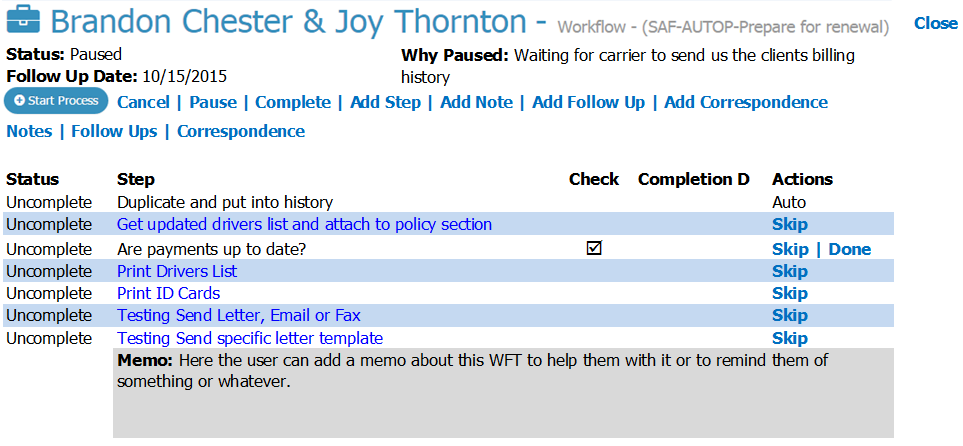
Rather than relying entirely on memory or a separate workflow manual, the CSR will be able to work through the process step by step, using the tools already built into CP Manager.
Notes, Follow-Ups, Attachments, Correspondence, and other functions will become part of the workflow itself.
The WFTM is being designed with more than 90 available workflow steps to accommodate different policy tasks and requirements, including those specific to individual carriers.
And what happens when the CSR can't finish the task because they're waiting for information from a client or carrier?
The workflow will be able to be paused, the reason documented, and a Follow-Up established so the unfinished work isn't forgotten.
Multiple workflows will be able to run for the same client—even for the same policy, such as an endorsement and renewal being processed simultaneously.
Open workflows will also be accessible from multiple areas of CP Manager, including My Activities.
Think about what this means for training CSRs, helping them process policy tasks consistently, and reducing how much they must remember on their own!
Instead of simply giving staff the features needed to process a transaction, the WFTM is being developed to help guide them through the workflow and connect them directly with the tools needed at each step.
That's a very different approach to workflow automation.
And it's why the WFTM couldn't simply be added as an afterthought.
We had to build the foundation first. Then re-engineer and integrate the features. And now we're bringing those pieces together through the Workflow Task Manager.
We've spent years getting to this point.
And I genuinely believe this upcoming feature has the potential to be a game changer for independent insurance agencies.
I can't wait for it to be released!
We share more information about the WFTM and are making agencies who purchase CP Manager prior to Jan 31, 2027 one heck of a deal, which we explain at this article:
You Can Always Add Features. You Can't Go Back and Rebuild the Foundation
The Philosophy Behind CP Manager
CP Manager's fundamental design philosophy is as relevant today as it was when I began:
Productivity isn't determined simply by the features a system offers. It's determined by how efficiently those features help staff get their work done.
And that's what makes CP Manager's approach to agency productivity different.
By the way, people frequently ask why I named it CP Manager.
The C and P stand for Client Policy Manager, but they also represent Commercial Lines and Personal Lines Management.
What do you think? Did I name it right?
5. What CP Manager's Productivity-Driven Design Means for Independent Agencies
So what does all of this mean for independent insurance agencies?
Like other agency management systems, CP Manager was created to help agencies operate more efficiently, increase staff productivity, and improve profitability.
What makes CP Manager different isn't what we set out to accomplish. It's HOW we designed the system to accomplish it!
Rather than taking the traditional feature-driven approach, CP Manager was designed from the ground up around productivity strategies and the workflows agency staff perform every day.
That approach influenced virtually every aspect of CP Manager's design, from its underlying table structures and the way information flows throughout the system to how individual features were re-engineered, integrated, and positioned to support staff as they perform their daily work.
The result is an agency management system designed to eliminate unnecessary steps, reduce repetitive work, and help staff accomplish their tasks more efficiently.
Features aren't added simply so we can say CP Manager has them. Every feature must serve a specific purpose, and first and foremost, help agencies increase their productivity.
And when a feature is added, it isn't simply plugged into the system. It's designed and integrated to work with the other features throughout CP Manager.
The results of this different approach can be seen throughout the system, often in ways that aren't immediately obvious until you actually experience them.
Handling A Routine Policy Endorsement
Think about a CSR processing a routine policy endorsement.
The CSR may need to review policy information, document a conversation, create a Follow-Up, prepare correspondence, attach supporting documents, create an endorsement memo or PCR, access the carrier's agent portal, and track the progress of the transaction.
Nothing unusual here. These are simply the activities involved in getting the job done.
But here's where things get interesting!
In a traditional feature-driven management system, the CSR may have to navigate from one part of the system to another to access the different tools needed to process that endorsement.
Open a window, complete an activity, close the window, navigate to another part of the system, open another window, and repeat.
And sometimes the CSR must close a window simply because it has locked the client or policy record, preventing them from moving forward until that window is closed.
Now, right in the middle of processing that endorsement, another client calls!
The CSR needs to pull up that client's information and handle their request.
But what if the management system only allows two or three client records to be open at a time?
Now the CSR may have to close what they're working on, handle the interruption, and then reopen the original client and policy records to resume the endorsement.
And hopefully remember exactly where they left off!
Notice something? None of those extra steps had anything to do with actually processing the endorsement or servicing the client. They were steps the software required!
Now, let's process that exact same endorsement in CP Manager.
The CSR still performs the same necessary activities. Nothing about the actual policy transaction has changed.
What changes is how the management system supports the CSR while performing those activities.
Instead of constantly navigating around the system looking for the next tool, CP Manager's re-engineered features are tightly integrated and readily accessible where the CSR is working.
Notes, Follow-Ups, Attachments, Correspondence, and other essential functions are designed to work together, reducing unnecessary navigation, repetitive entry, and extra steps.
And remember that interruption when another client called?
Here's where CP Manager's design really makes a difference. CP Manager allows staff to have unlimited clients and policies open simultaneously. And it doesn't lock the client or policy records!
Think about what that means.
The CSR can be working on an endorsement, take a call from another client, open that client's information, handle the request, and return to the original endorsement without having to close the original client or policy records simply to make room for the interruption.
And if another client calls? Or the CSR needs to reference a different policy?
No problem!
The software isn't forcing the CSR to close one client's records just to work with another client's records.
That's a significant difference in how the system supports the realities of an agency's workday. CP Manager lets you open up unlimited clients and policies.
Same endorsement. Same required activities. Same interruption.
But a dramatically different experience for the CSR—and potentially a dramatic difference in the time required to get the work done!
Small Time Savings Can Produce Huge Agency-Wide Productivity Gains
Now multiply those unnecessary steps by the number of transactions each CSR handles every day, then by the number of CSRs in the agency.
Suddenly, we're not talking about saving a few clicks.
We're talking about recovering valuable staff time, day after day, simply because the management system was designed differently!
The CSR can spend less time operating the software and more time servicing clients.
And that's where productivity begins to multiply.
Consider a CSR saving just five minutes on an activity performed 20 times a day.
That's 100 minutes recovered each day.
Across three CSRs, that's 25 hours of potential staff capacity recovered in a five-day workweek!
That's an illustration, not a guaranteed result. Actual savings depend on the tasks performed and the agency's existing procedures and on the system they're currently on.
But it demonstrates why reducing unnecessary work matters so much.
Now consider the broader implications.
Staff may be able to service more clients, manage larger books of business, complete their daily work with less frustration, and have more time available for revenue-producing activities.
Agency owners may gain the capacity to grow without having to add staff at the same rate.
And for smaller agencies, the benefits can be especially significant. That's because smaller agencies generally have fewer resources and less financial cushion to absorb wasted staff time and lost productivity.
When every person on the team wears multiple hats, helping them accomplish more work in less time isn't simply a nice benefit. It can make a substantial difference in the agency's ability to compete, grow, and remain profitable!
This is what CP Manager was designed to accomplish.
Not simply to give agencies another way to manage their clients and policies.
But to help them manage their entire operation more efficiently.
The Difference Is in the Details
Some of the most significant productivity improvements come from functions agency staff use every day.
That's why CP Manager's design paid particular attention to the integration and efficiency of core activities such as:
- Notes and documenting conversations and activities.
- Follow-Ups and managing outstanding work.
- Attachments and document handling.
- Correspondence and communications.
- Accessing client and policy information.
- Processing policy tasks and managing daily workflows.
These aren't necessarily exciting features when viewed individually.
But when they're re-engineered and tightly integrated to work together, they can fundamentally change how efficiently staff accomplish their work.
And rather than simply tell you how CP Manager is different, we'd like to show you.
6. Why We're Sharing This Story With You
Whether you're an agency owner, CSR, producer, or another member of an independent insurance agency's staff, there's something we believe we all have in common.
You want your agency to succeed!
You want to provide excellent client service, operate efficiently, remain competitive, grow your business, and improve profitability.
And if you're like most agency professionals, you'd probably welcome the opportunity to accomplish more during your workday—with fewer frustrations and less wasted time.
That's why we're sharing the story behind CP Manager.
For decades, agency management systems have continued to evolve, introducing new features and capabilities to help agencies manage their clients, policies, and everyday activities.
And those advancements have been valuable.
But here's a question worth considering.
What if the greatest opportunity to improve your agency's productivity isn't adding more features—but fundamentally changing how the features you use every day work together?
That's the thinking behind CP Manager.
We designed CP Manager around what I believe should be the primary objective of every agency management system: Helping agency staff accomplish the most work in the least amount of time!
Think about how many activities your agency handles every day.
Client inquiries. Policy changes. Renewals. Follow-ups. Notes. Correspondence. Attachments. And countless other activities that keep your agency running.
Those activities still need to be completed, regardless of which management system you use.
But the number of steps, the amount of repetitive work, and the time required to complete those activities can be dramatically different!
And those differences matter.
Saving a minute here or a few minutes there might not seem significant. But multiply those savings across hundreds of activities, multiple staff members, and every working day.
Suddenly, we're talking about a substantial opportunity to increase your agency's productivity.
That means more capacity to handle additional business, better client service, improved profitability, and fewer of the everyday frustrations that slow your staff down.
And ultimately, isn't that what agency automation is supposed to accomplish?
This approach didn't happen by accident.
It's the result of decades of firsthand agency experience, years of studying productivity strategies and workflows, thousands of pages of detailed system blueprints, and a commitment to re-engineering how the fundamental functions of an agency management system work together.
We're not asking you to believe CP Manager is better simply because we say so.
And we're certainly not suggesting that other management systems haven't contributed significantly to the advancement of agency automation.
They have!
We're simply inviting you to discover what becomes possible when an agency management system is designed around productivity and workflow efficiency from the very beginning.
Because whether you own the agency, service its clients, or produce new business, your time matters.
And shouldn't your management system be designed to help you make the most of it?
Don't Take Our Word for It. Experience CP Manager for Yourself... We'll Let You Drive!
We'd like to invite you to experience CP Manager firsthand through a personal Walk-Through.
But this isn't the typical software presentation where someone demonstrates a long list of features while you sit back and watch.
You Drive!
We'll guide you through the system while you experience firsthand how its features work together to support everyday agency activities.
See how information is organized.
Explore how the core functions work together.
Experience how CP Manager's productivity-driven design helps reduce unnecessary steps and makes it easier to get your work done.
And most importantly, discover for yourself why the design of an agency management system can make such a significant difference in your agency's productivity.
The story explains WHY we created CP Manager. The Walk-Through lets you experience HOW we designed it differently.
Schedule Your WalkThrough — You Drive!
We believe that once you've experienced CP Manager firsthand, you'll understand why we're so enthusiastic about helping independent insurance agencies discover this different approach to productivity.
CP Manager by Agency AutomationTEAM
Giving You Back Your Time.